Showing posts with label reading notes. Show all posts

Tuesday, April 25, 2017

Reading Notes: Anderson's Fairy Tales, Part A

Some of these stories I'm very familiar with; some, I haven't heard or thought about since I was younger; some, I hadn't read at all. They were all charming in different ways, so I'm interested in examining all of them, including the less popular ones. This post will focus on pitching rewrite ideas for each story and playing with genre. I'm a fan of fantasy and sci-fi, and I miss writing it, so most of these ideas will have elements of those genres.

The Princess and the Pea
I'm surprised at how short this story is. It could use more exposition and detail. The most major part of the story to be preserved would be how the princess inadvertently proves her identity as a result of her delicate senses. So, maybe with a rewrite in an urban fantasy setting, the princess (or prince) could be of questionable species. Maybe she must be invited into the castle, and seems to evade all its interior mirrors and other reflective surfaces. So, the king or lord of the castle suspects her, and puts garlic into her room while she's asleep. In the morning, she complains of allergies/poisoning. By the end, the castle's lord/king finds that she's a vampire, and stakes her.

The Emperor's New Suit
 This story is one of my childhood favorites, but I'm at a loss for how to tweak it for the fantasy genre. Maybe the suit itself is real, like a magic item, and gets into the hands of someone besides the emperor? The trickster characters who create the suit would be central to the story.

The Brave Tin Soldier
 Since this story has so much adventure, it begs to be extended. One thing I don't like about it is how the characters are toys, so they're totally vulnerable and dependent on fate to move them around since they can't move themselves. In a sci-fi rewrite, the tin soldier could be changed to a robot. Maybe a toy or cleaning robot--something mundane. He could fall in love with a mannequin, maybe who is damaged or missing a part where the robot is, too.

The Wicked Prince
This story I have never read before, or heard of at all, but I love it! The idea of fighting an angel in an airship is epic. In a rewrite, the prince (or princess) would be the same as the original, personality-wise: ambitious and selfish. He wants to destroy God because he thinks he's powerful enough. Also, he has a flair for the dramatic, and a flying ship that can shoot hundreds of guns at once. In a fantasy setting, as mentioned, this ship would be an airship (or spaceship, if sci-fi). I'd want to keep the angel as the final antagonist--but maybe it would be a really Old Testament angel, with a number of wings and faces and eyes where they shouldn't be.

The Little Match-Seller
This is the only story I don't think I could genre-bend effectively. It seems like changing any of the story elements would just undermine the message. It works because of its simplicity. Sad potatoes.

Source: Hans Christian Andersen's Fairy Tales and Stories
Image: Max Pixel: Mannequin

Tuesday, April 18, 2017

Reading Notes: Dante's Inferno, Part B

It would be difficult to write something that could encapsulate everything the Inferno offers its readers. And there are already a ton of adaptations, but aside from translations, these are complete works in themselves. 

It would be hard to write one self-contained story, unless it were something like the story of Paolo and Franchesca. Still, it wouldn't be complete with out the complete context of Dante's whole Inferno. What to write that could fit under 1k words?

I like the idea of writing a multi-chapter short story about someone who is traveling through a place like the Inferno, but an adaption of it. Since the Inferno is an allegory, I think it would be cool to write a story to re-purpose the allegory. So, maybe it's not religious in nature, but still illustrates the consequences of various sins by way of punishing them as either a natural consequence or committing those sins (like how Dante's diviners can only see behind them as a result of trying to discern the future), or via some kind of punishing device (like the three humans in the devils' three jaws). The setting could be somewhere on earth, like a city where crimes against human rights run rampant--like, a city of rain to contrast the fires of hell, or a city of cold fire.

I think this should be less religious and more based on human rights so it can be more general. Back in Dante's day, 99% of his readership would have subscribed to the same religion as him, but today there's much more discussion of human rights and happiness and laws in a secular sense. Not all of Dante's circles would fit in this context, but some would. Here are a few:

Limbo, the first circle, "contains the unbaptized and the virtuous pagans, who, although not sinful, did not accept Christ... After those who refused choice come those without opportunity of choice." Maybe one way to translate this would be those people who witnessed crimes against humanity but didn't take action against them?

Heresy, the sixth circle, condemns its sinners to "eternity in flaming tombs." This would be the most difficult to adapt, since heresy is religious by definition. But there's also this: "any belief or theory that is strongly at variance with established beliefs, customs, etc." So, maybe, going against the norm in a harmful way? Or in a way that provokes additional consequences? You have things like not paying taxes, which isn't always considered morally terrible, but definitely has its consequences. But what about something taboo that doesn't fit into any of these other categories? It would be like pouring the milk before the cereal--but actually, you know, serious.

The other circles--lust, gluttony, greed, wrath, violence, fraud, and treachery--are self-explanatory.

I don't think I'd be able to write this in under 1k words, so this post will be part of my future writing wishlist. Ideally, it would be in a journal or epistolary format.


Sources:
Tony Kline: Dante's Divine Comedy
Wikipedia: The Inferno
History Lists: The 9 Circles of Hell
Dictionary.com: Heresy

Image: Pixabay: Journal

Friday, April 14, 2017

Reading Notes: Dante's Inferno, Part A

In high school, I wrote a ten-page paper over one of the Inferno's various allegories. To be honest, I can barely remember the specifics of what I wrote about, besides that it centered around Virgil.

File:Dantes Inferno - Levels of Hell.svgI do remember, however, that when I wrote that paper, the video game adaptation of the Inferno had just come out. I had done a bit of my own research over the game, only to conclude that it was quite a bit different from the text. This seems to happen a lot, especially to the Inferno. It seems to be a popular text for game developers to reference, too, interestingly. The video game "Dante's Inferno" is the most on-the-nose, even though the story is different. The game's plot features Dante, who is a sinner searching for repentance, journeying into Hell to rescue his love Beatrice, as she has been captured by the Devil. In reality, Beatrice doesn't appear in the Inferno at all, and is only mentioned. In real life (as far as I can remember from high school, anyway) Beatrice and Dante were decidedly not lovers. Instead, Dante was a little obsessed with Beatrice, and wrote about her constantly. Their relationship sounds a little more like a stalker-thriller than a love story.

Regardless of all that, the game stays faithful in the game's environment, which is definitely where the game potential always lied. Dante's descriptions have spawned dozens of paintings and sculptures, so it follows that the next adaptation would be highly visual, too. And in a video game, players can explore the nine themed layers of hell. As far as I can tell, the level design is fairly close to the text's descriptions. For example, the final few hours of game play take place in an icy ninth circle of hell alongside the Devil.

I could go on, because I legitimately think video games are one of the coolest mediums to adapt the Inferno to varying degrees. They're all about exploration, world building, and visuals. There's a much longer list of games that have referenced the Inferno without outright adapting it; to name a few--Devil May Cry, Bayonetta, Castlevania, Fallout, Resident Evil, all of which are popular/successful franchises.

Basically, I'm all about video games as storytelling mediums, and it's so cool how a work as old as the Inferno can be adapted to such a new form of media.

Sources:
Tony Kline: Dante's Divine Comedy

Wikipedia: The Divine Comedy in Popular Culture
TvTropes: Word of Dante

Image: Wikimedia Commons: Levels of Hell

Tuesday, April 11, 2017

Reading Notes: Britomart, Part B

One of the most interesting things about Arthurian lit for me is the multitude of magic items. I considered writing a post like this for the King Arthur unit, but decided on other things. This post will focus on three major magic items in Britomart's story: the magic mirror, Britomart's spear, and the golden girdle.

The mirror spurs Britomart into beginning her quest. The mirror itself was enchanted by Merlin, and by description sounds more like a large crystal ball. It's round and hollow, like "a great globe of glass." The mirror has the power to show any person looking into it anything the looker wants to see; the power "of showing perfectly whatever thing the world contained, between heaven and earth, provided it had to do with the person who looked into it. Whatever a foe had done, or a friend had feigned, was revealed in this mirror, and it was impossible to keep anything secret from it." Knowing this, Britomart looks into the mirror and deliberately wishes to see the person who she would marry some day. The mirror, of course, shows her Sir Artegall, and, immediately falling in love, she sets out to find him.

The spear is Britomart's weapon of choice. Sir Guyon encounters it within the first few paragraphs of the reading. When he rides towards Britomart to joust her off her horse, he's thrown to the ground instead because of the spear. The narration assures us that, despite his shame, "it was no fault of his own... the spear that brought him to the ground was enchanted, and no one could resist it."

The golden girdle is the prize given for the tournament in the second part of the reading--sort of, because it's supposed to be given to the most beautiful lady. I'm not sure how this works. If I understand correctly, the girdle chooses the most beautiful lady, while the knights compete for the hand of the lady who is chosen, and who is thus the most beautiful. It's not just a prize, it's a magic item which gives "the gift of constant and loyal love to all who wore it, but whosoever was false and fickle could never keep it on, for it would loosen itself, or else tear asunder." Personally, I like the idea that the girdle is like Thor's hammer or Excalibur--it's sentient, and chooses its master.

Source: Mary Macleod: Stories from the Faerie Queene
Image: Public Domain Pictures: Crystal Ball 

Monday, April 10, 2017

Reading Notes: Britomart, Part A

After finishing the first reading from this set, I'm very interested in knowing more about the The Faerie Queen. This post will mostly consist of background I found while reading about the work as a while, and then thoughts on the reading specifically.

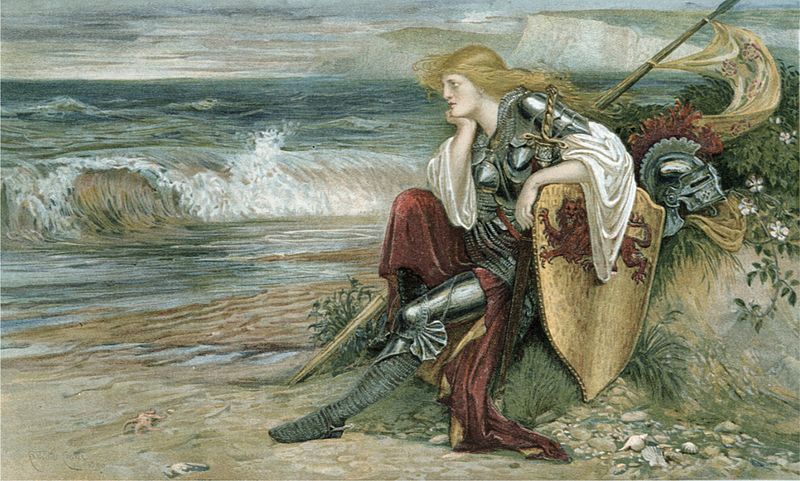
The poem follows several knights who represent different virtues. In this way, the work is allegorical, as poet Edmund Spenser intended. He states the work is "enwrapped in allegorical devices" and aims to "fashion a gentleman or noble person in vertuous and gentle discipline." Britomart is the protagonist of Book 3, and represents chastity. She also meets Book 1 protagonist, the Redcross Knight, who represents holiness, Book 2 protagonist Guyon, representing temperance, Artegal, representing justice, and Arthur, representing "magnificence, the perfection of all virtues."

File:Walter Crane - Britomart (1900).jpg
Walter Crane's Britomart from Wikimedia Commons
It may be cliche, but my favorite thing about this work is the inclusion of a female knight as a main character. This is ridiculously rare as far as I can tell in Arthurian literature, given the number of knights overall. It's not just the fact that she's female--it's the idea that her presence complicates the idea of chivalry on which knighthood is built in these works, not to mention the ideal relationship between knights and ladies. The text is aware of this, saying: "Through all ages it has been the custom that the prize of Beauty has been joined with the praise of arms and Chivalry. And there are special reasons for this, for each relies much on the other: that Knight who can best defend a fair Lady from harm is surely the most fitting to serve her, and that Lady who is fairest and who will never swerve from her faith is the most fitting to deserve his service."

Also of note is the fact that Britomart's name (as Britomartis) is recycled from a Minoan and Greek goddess of mountains and hunting. In Greek, she was a mountain nymph associated with Artemis. In Crete, she was known as a mother of mountains associated with gorgons, "double-axes of power," and snakes. She must have been a fearsome and dangerous figure, but this aspect of her character was also softened by her status as a "good virgin" goddess. This carries through into The Faerie Queene in that she is a figure of chastity and virtue, but also one of honor and power. Her name carries extra meaning as well, in that "Brit" denotes "Briton" and "Martis" could mean "of Mars," the Roman god of war.

Sources:
Mary Macleod: Stories from the Faerie Queene
Wikipedia: The Faerie Queene
Wikipedia: Britomartis

Tuesday, April 4, 2017

Reading Notes: King Arthur, Part B

Here's a list of major Arthurian knights and characters connected to Arthur. As I worked through this reading, it was a little harder to keep track of the influences on the stories and relationships between characters. The notes are taken both from Wikipedia and information I already know about the characters.

King Arthur provides a framing device: the legendary king so noble and lawful good that he attracts the land's most talented and morally upstanding nights--but not more morally upstanding than him. Arthur is best known as a character and pseudo-historical figure in tales where he is an Excalibur-wielding king of Britain. According to most stories, he is born via the rape of a noblewoman by Uther Pendragon, and dies at the hand of his sometimes-nephew, sometimes-accidentally-concieved-by-incest son Mordred. Stories involving King Arthur tend to focus less on the king himself and more on the knights.

File:How Mordred was Slain by Arthur.jpg
Guinevere is Arthur's wife, who usually has an adulterous relationship with chief knight Lancelot on the side, but in earlier works tends to be forgiven for it. Arthur's round table was a gift from her father, King Leodegrance. She has been portrayed as "everything from a weak and opportunistic traitor to a fatally flawed but noble and virtuous gentlewoman." Sometimes she is intelligent, friendly, and graceful; other times, she's a vindictive and weak-minded opportunist.

Mordred is Arthur's would-be usurper, sometimes Arthur's illegitimate son with his half-sister Morgause, sometimes with Morgan le Fay. In some literature, he's instead the son of King Lot, brother to Gawain, Agravain, and Gareth, two of whom are Arthurian knights with their own stories. He and Arthur kill each other in combat.

Now the knights:

Lancelot is Arthur's favorite knight, known to be the best earthly knight on earth. His legendarily adulterous love for Guinevere characterizes him as fatally flawed, but in many works, this love is what gives him so much strength. It also makes him a very bitter person.

Gawain is the James Bond of the round table, as he always stops for a lady in need. However, this happens to be because he once killed a lady by accident when dueling with her husband. As a result, he is honor-bound to always help a lady who is in distress.

Galahad is Lancelot's son, and considered the purest and most noble knight there is. He's one of three knights who achieves the Grail.

Percival is a younger and more naive knight, a welshman who learned to be a knight despite growing up in the woods with only his mother. His tale in Chretien de Troyes' Arthurian romance is the origin of the Grail quest.

Tristan has roots as a character before Arthurian myth, but his main story is his love for Isolde, who his uncle marries. That relationship is sometimes used as a parallel to the Arthur-Guinevere-Lancelot love triangle, but Tristan's story is more one-sided because his love with Isolde is considered more justified. His uncle is also a huge jerk who marries Isolde partially just to make Tristan miserable.

Yvain or Ywain is a lesser-known knight whose quest involves killing a lady's husband, falling in love with her, marrying her, breaking a promise to her and then becoming a hermit and going crazy as a result. He gets better, and also finds highly symbolic companionship in a wild lion.

Kay is Arthur's adopted brother and seneschal, and very antagonistic towards the other knights. To my knowledge, he has no tales of his own, but has adventures in other knights' stories. He's great because nobody really likes him all that much, and sometimes knights like Yvain end up taking on big adventures just to avoid being taunted constantly by Kay.

Sources:
King Arthur: Tales of the Round Table by Andrew Lang
Wikipedia: King Arthur
Wikipedia: Guinevere
Wikipedia: Mordred

Image:
How Mordred Was Slain by Arthur via Wikimedia Commons

Monday, April 3, 2017

Reading Notes: King Arthur, Part A

I have been looking forward to this unit for a long time. I'm taking a class over Arthurian Literature this semester, so I've read a lot of these stories already. In Part A, they all seem to be adapted from Malory's Le Morte d'Arthur, so I may use background information from Malory's stories in my notes.

One day, I'd really love to try re-writing a few Arthurian stories in my own style, especially those surrounding Merlin's birth and childhood, the Lady of the Lake, Lancelot, Gawain, Enide, or Balin. This set of stories features the Lady of the Lake a few times, so I may write a story about her. Supposedly, she has a handful of different names, including Nimue, Viviane, Vivien, Elaine, Ninianne, Nivian, Nyneve, and Evienne. This is because of the way her name was written in middle English, where the figurative hills and valleys of specific cursive letters would mimic each other. For example, an N could look like "Vi" and "mu" could look like "ine." I'll refer to her as Nimue.

File:The Lady of the Lake by Speed Lancelot.jpg
The Lady of the Lake from Wikimedia Commons
I love the scene in The Sword Excalibur where Arthur and Merlin approach the lake in hopes of finding the sword. The Lady of the Lake appears to them and agrees to give Arthur the sword in exchange for a favor. Once she disappears, Merlin points out that the sword is valuable, but not as much so as the scabbard, which magically keeps Arthur from bleeding out as long as he has it on his person, no matter how much he's wounded. I like the idea that the sword and scabbard have  to be together in a set, otherwise they don't work.

Many depictions of this scene are set in spring and summer, with flowers and long green grass sprouting at the edge of the lake, but what if it were set in winter? The surface of the lake would be frozen over, with a single frostbitten arm sticking up from the middle of the water clutching a frosty sword. Arthur and Merlin would have to bravely creep out onto the frozen surface to retrieve Excalibur.

Nimue also appears in The Passing of Merlin, where she is responsible for his death, which really complicates her character. In the story, it seems to be because Merlin had an irritating crush on her and wouldn't leave her alone.

I'm interested in writing a story where the Lady of the Lake becomes an antagonist. I have a lot of stories so far with female main characters, but none I can think of with a female villain. This would be an excellent reversal because the Lady of the Lake is so often depicted as a force of good. In Malory's work, however, she is actually part of a cycle of revenge that kicks off Balin's story. Maybe I could write a story revolving around her plot to kill Merlin. She could wield Excalibur, too.

I'd like to preserve Malory's characterization of her, too. She's pragmatic, knowledgeable, clever, strong-willed, and unflinching. My goal would be to make her a sympathetic antagonist.

Sources:
King Arthur: Tales of the Round Table by Andrew Lang
Wikipedia: Lady of the Lake

Tuesday, March 28, 2017

Reading Notes: Alaskan Legends, Part B


Two stories stood out to me in this set of readings: "The Land of the Dead" and "The Ghost Land." I'm so pleasantly surprised to find what are basically a set of ghost stories here. So spooky.

The Land of the Dead is an Eskimo story about a woman who dies and is put in a "grave box," but is woken up by her grandfather, who tells her she is not dead. She visits a village of dog shades, where she is whipped like a dog, either because she is a shade herself, or because she appears to be a dog to them. Either way, this is an aesop about being kind to dogs and not beating them. Next, she comes to a river made of tears from people who weep for the dead, which is about as heavy metal as you can get. Excellent setting for a ghost story. After she crosses the river, she ends up in a village on the other side, the "land of the shades." She meets her grandmother, who tells her that her grandfather led her here because "the last person thought of by a dying person hurries away to show the road to the new shade." The very last line drops this on us: "Thoughts are heard in the land of the shades." Ghostly whispers for the living, maybe?

This would make a fantastic horror story or ghost story. It could be Sixth Sense-esque, where the girl wakes up without any memory of how she ended up in a grave box/coffin, and comes across these fantastical locations. She would only realize she's dead once she came to the village of the shades. Maybe, taking the final line of the reading into account, she could hear people's thoughts, too.

The Ghost Land is a Tlingit legend similar to the above. A man's wife dies and he grieves endlessly. The only way he can deal with it is to walk--so he walks for days and nights on end on the "Death Trail." He eventually comes to a lake and calls to the village on the other side. They seem not to hear him, but notice his presence, saying, "Some one has come up from Dreamland. Go and bring him over." He finds his wife there, who warns him not to eat any food the villagers there give him. She returns with him to their home village, but nobody can see the wife. That night, when the husband goes to sleep, he passes away too, and they return to the ghost land together.

File:Death Canyon Trail.jpgThis story has several "otherworld" or "reverse world" elements, the most obvious of which is that the people from the two villages are not able to mix. It's interesting that in the ghost land, the living village and its world is referred to as "dreamland." This makes it seem like death is just a progression to another type of life, not an afterlife in the traditional sense. Just a graduation to a different village across the lake you could find by following the Death Trail.

Sources:
Myths and Legends of Alaska, edited by Katharine Berry

Image:
"Death Canyon Trail" via Wikimedia Commons

Monday, March 27, 2017

Reading Notes: Alaskan Legends, Part A

Raven is a shapeshifter: an animal and a human, but neither. He is a villain and a savior, and a god and an annoyance. His contradictory nature probably comes about as a result of the many, many stories about him. I'd love to read something that explores him more closely as a character. He's symbolic of many humanlike qualities, and very quirky.

According to Wikipedia, "Raven and eagle are known by many different names by many different peoples and is an important figure amongst written and verbal stories. His tales are passed down through the generations of story tellers of the people and are of cultural and historical significance. It's important to note that Native myths such as the Raven Tales, as opposed to tall tales and little stories for children, are not entertainment and are cultural property of the clan or individual that the story originates from." This explains many of the shorter stories. They seem random to a modern-day American reader, but that's because we can't relate to the daily life experiences of a Native American child to whom stories like this would be told.

Also of interest, noted on Wikipedia: "It is customary that others should not tell stories that are owned by another clan, especially if they do not live in the same area" (Giese, Paula (1996). "Who Owns the Stories — A Letter to Eldrbarry").

This raises questions. Should I try retelling any of these myths, or should I make a different story in a similar style to avoid encroaching on others' cultural property, so to speak?

I'm considering the idea of writing a story that features Raven as the main character, but that also pulls elements from several different stories in the collection. For the most part, those stories would be "Raven's Marriage" and "The Naming of the Birds." By the time these stories take place, Raven has detatched himself from human civilization despite all his work to help it. He seems to prefer the company of animals--or bird shapeshifters like himself, rather. These birds are sapient and shift back and forth between human and avian like he does, but they don't seem to associate with humans at all.

In "Raven's Marriage," Raven finds himself in want of a wife. For all his travel and mischief, he's lonely--or maybe he just wants a new target to bother. After some searching among the other birds, he finds a family of geese, including a young female goose. They are married for a matter of days, before the family of geese' large wings leave Raven unable to keep up with them and he is left behind.

I like the image of the dark-feathered Raven being visually contrasted with a white bird. A goose isn't exactly the ideal counterpart for a raven. Geese aren't very mysterious. However, Wikipedia gave me this: "The Sioux tell of how a white raven used to warn buffalo of approaching hunters. Eventually an angry shaman caught the bird and threw it into a fire, turning it black."

Sources:
Myths and Legends of Alaska, edited by Katharine Berry
Wikipedia: Raven Tales 

Image:
"The Raven" via Flickr

Tuesday, March 21, 2017

Reading Notes: Native American Hero Tales, Part B

Lodge-Boy and Thrown-Away is so weird and cool. So many questions raised and never answered: Who is the Red Woman and why did she kill the twins' mother and impale her like a puppet? Thrown-Behind the Curtain (hereafter "Thrown-Behind") is every bit the prodigal hero as Hector or King Arthur--he's less sophisticated, but arguably way more cool. He slays a massive alligator whose organs are apparently in plain view, kills a witch with her own cauldron, and raises the dead on one occasion. Because he feels like it. This culminates into the legendary Thunder-Bird itself giving Thrown-Behind the task of killing a giant otter that has been threatening its eggs.

Dirty-Boy was more of a classic example of mythology, revolving around two gods, Sun and Star, who disguise themselves and infiltrate an Okanagon village. I especially loved the descriptions the writer gives for Sun and Star. Star is "a woman ... wearing a long skin dress covered with star pendants, with bright stars in her hair," while Sun is a handsome man, and "his garments and hair were decorated with bright suns." Up to this point, Sun and Star have been a haggard old woman and a dirty, scrawny young man respectively, so interestingly, this story is like an Okanagon version of Beauty and the Beast.

I'm hurting for more portfolio stories, so I need to pick one of the above stories to rewrite. Dirty-Boy would be interesting if the two sisters--who sort of function as point of view characters--were plain or even ugly instead of beautiful. The story involves the young men of the village pursuing them. But what if they weren't beautiful on the outside? A simple change, not as big a reversal as the other two stories in my portfolio right now, but it would alter the story in a big way. Instead of being pursued, the sisters--one or both of them--would be lonely. Sun's disguise of a "dirty, sore-eyed boy," and Star's disguise of "a very old woman in ragged clothes," would be off-putting to other villagers, but perhaps not to a girl (or girls) who feels just as cast aside. Ultimately, the pair could take the main character(s) up to the sky, with an opportunity to include the story's ending with stardust: "when the liquid ran down over [the sister's] hair and body, lines of sparkling small stars formed on her ... the liquid ran to the chief's lodge, forming a path, as of gold-dust."

"Glitter" on Pixabay

Source: Tales of the North American Indian by Stith Thompson

Monday, March 20, 2017

Reading Notes: Native American Hero Tales, Part A

Of the stories I've read so far from this week's reading, my favorite is "The Attack on the Giant Elk and the Great Eagle." It's no lighthearted story, since the Apache hero, Jonayaiyin, kills the titular giant elk and then uses its antlers to stab the great eagle.

File:Irish Elk.jpg
Irish Elk by Postdlf
I think adapting this story would be fun. On one side, you have the classic Disney story elements: Jonayaiyin, a hero with a destiny; two huge villains threatening the land he comes from; even animal companions like Gopher and Bat. Add in a few more characters, like his mother and brother, and the story becomes a Disney tale.


Alternatively, the story could be turned into a Wicked- or Maleficent-style switch-up sympathizing with the elk and/or eagle and giving their backstory a different twist. For example, instead of killing and eating humans, they could be misunderstood protectors of humanity who have to contend with a demigod who is trying to kill them.

Finally, it could be a Road to El Dorado-type story where the hero is not actually the demigod he claims to be, and must try to survive an encounter with the monstrous animals he is supposed to kill.


I'm also interested in Jonayaiyin's brother, Kobachischini. The former is the son of the Sun, and the latter is the son of the Waterfall, both by the same woman. Kobachischini never shows up; according to the reading, he "remained with his mother while his brother went forth to battle with the enemies of mankind." I would love more--a story where Kobachischini goes on his own quest, and then a story where they meet as rivals.  While Jonayaiyin seems to be more of a fighter with a hot temper, Kobachischini could be his cool-headed counterpart, being the son of the Waterfall. Their mother could function as a mediating presence between them, and their fathers as mentors, or even antagonists.

Source: Tales of the North American Indian by Stith Thompson

Tuesday, February 28, 2017

Reading Notes: Japanese Fairy Tales, Part B

The second half of this reading delivered: more animal stories and characters. However, the human characters were a little different than the virtuous human characters in the first half of the reading.

The tale of Uraschimataro and the Turtle was the biggest outlier in both days' readings. The main character witnesses his share of magic, marries the Sea Princess, and very nearly ends his own story in total happiness. The problem begins when he returns to his home and sees that his parents are dead. This grief causes him to second-guess his wife's instructions to refrain from opening the golden box she gave him. When he opens it, his age catches up with him and he withers and dies within what seem to be hours. What's the purpose of this? Is there an obscure lesson to be learned here? Obey your spouse? It comes off as if the Sea Princess is testing Uraschimataro by giving him the box in the first place. Or maybe it's just a fairy story.

The merchant in The Magic Kettle wasn't conventionally good or bad--the story simply called on him to be humble and share his wealth with the farmer from whom he bought the kettle. It's a simple story. Beyond that lesson, the story also serves to introduce the tanuki. In The Magic Kettle, the tanuki isn't wicked yet. Maybe it's a different tanuki than the one in the next two stories, who killed his own wife out of greed and neglects his child. In another story, the tanuki kills, cooks, and serves a human man his wife.

After doing a little research, I found out that the tanuki is a real creature--a subspecies of of the Asian raccoon dog. In Japanese folklore, tanuki are known to be similar to kitsune (fox demons), and can shapeshift into and/or possess humans.

Sources:
Andrew Lang's Japanese Fairy Tales
Wikipedia: Japanese Raccoon Dog

Image:
Tanuki by 663highland

Monday, February 27, 2017

Reading Notes: Japanese Fairy Tales, Part A

For the first part of this reading, I decided to try something new and listened to it via the LibraVox audiobooks. This added an interesting new element to the stories themselves--each story was read by a different person, all with many different accents and different ways of reading. It's cool that audiobooks are an option for this class--definitely something to keep in mind in the future.

I chose another Japanese reading because I enjoyed the Japanese Mythology so much. The old Japanese backdrop adds something interesting to what would otherwise be standard fairy tales.

My favorite was the story of The Cat's Elopement--reading or listening, it's a very relaxing and sweet story. One my favorite series in my middle school days was the Warrior cats series, so I may have a soft spot for feline main characters. Still, the imagery in The Cat's Elopement was so wholesome and comforting that I think I have to recommend it anyway. If you're reading this, and you feel stressed, try putting on the audiobook of this eight (or so) minute story and listening as you fall asleep.

The other stories had a similar tone--lighthearted enough to be children's stories, not dark enough to be something out of the Grimm Brothers' stories (which is fine with me). The Two Frogs was a unique story about a simple mistake with a big impact. The Envious Neighbor and The Sparrow with the Split Tongue were both classic tales that put Nice and Good protagonists against Mean and Bad antagonists who ultimately got what they deserved. What kept them interesting was the magical elements--a dog with a nose for gold and who can magically help its owners from beyond the grave, and a sparrow who transforms into a princess. The Nice and Good protagonists, of course, were rewarded for their goodness by these very magical elements.

I look forward to reading tomorrow's section, too.

Source:
Andrew Lang's Japanese Fairy Tales

Image:
"My favourite! Sparrow flavoured peanuts" by John Haslam

Tuesday, February 21, 2017

Reading Notes: Japanese Mythology, Part B

For the most part, this reading focused on the Japanese hero Yamato Takeru, or Yamato Take. I did some research to find out more about the story and its background, but it looks like there's more than one version. Several of the summaries floating around are just vague enough that I can't tell if they're supposed to be the version in the reading, or if they're just similar enough to be confusing.

However, I think this version would be great to use to adapt the story of Yamato into a novella or novel. It could even fit into a neat, three-act screenplay structure. Unlike the Egyptian mythology stories, this story is long enough, and the main character developed enough, that a writer could get away with adapting it for modern audiences. 

The protagonist is the main selling point here. He has a handful of major flaws, like any good main character, and is far from perfect at any point in the story. He is also actively a jerk to other people, like Princess Tachibana, but by the end of his story, he suffers hardships, learns a lesson, becomes a better person, and almost manages to end his own story happily. If I were the one writing this story, I might edit the ending a little--instead of Tachibana sacrificing to the sea god and Yamato living the rest of his life in grief, I would try to resolve the conflict. There could be a (Disney) Hercules-type showdown where the hero travels to the underworld (or to the heavens) to find his wife's soul and bring her back to life. Or, Yamato could do something sacrificial to bring her back. For that matter, I probably wouldn't write Yamato and Tachibana as being married for most of the novel. The relationship seems so one-sided that it would make Yamato seem like a huge jerk, if it were written that way. An alternative could be making them engaged, or putting them in an arranged marriage, but marrying them at the end of the story instead.

The antagonist is almost as interesting as the protagonist. Benten exploits Yamato's flaws for her own gain, so he can only beat her by overcoming his own weaknesses. The rest of the plot could be fleshed out with Yamato's labors, like the episodes with the glass-cutting sword and the boar.

Sources:
Romance of Old Japan, Part I: Mythology and Legend, by E. W. Champney and F. Champney

Image:
Yamato Takeru at 16, by Tsukioka Yoshitoshi

Monday, February 20, 2017

Reading Notes: Japanese Mythology, Part A

If you have an interest in Greek myths, you should check out these Japanese myths, too. They feel familiar, but have new cultural elements and characters. It's like being able to re-read one of your favorite books and discovering the story all over again.

Since I decided to go with the theme of reversal with my portfolio, I will be choosing one of the stories in the collection to re-write. However, I'll begin with a recap of the gods--who they are, how they came to be, and the background for the story up to its events. So, possible stories:

Izanagi and Izanami. Izanagi flees from Izanami in the underworld. Instead of escaping, Izanagi is caught by the spirits his wife sends after him. Instead of Izanami vowing to take 1000 lives every day, and Izanagi vowing to give birth to 1500 more, Izanagi is forced to pay as many souls to his wife as a ransom. If Amaterasu, Susanoo, and Tsukuyomi were involved, they might be the ones to free Izanagi from Izanami's control. Or, they could be hostages who Izanagi is trying to free.

The Serpent of Koshi. Susanoo is defeated, and his bride-to-be, Kushinada-hime, tames the serpent instead. So, lacking a husband, but having gained a dragon, Kushinada takes Susanoo's place as the deity of summer storms. The serpent of Koshi could be the one who transports her around on its back, its roars could be thunder, and its eight long necks could evoke an appearance of white thunder.

The Heaven-Descended. In the original, Amaterasu appoints her grandson Ninigi as ruler of Japan. In a reversal, Amaterasu could appoint another of her grandchildren--Uzume, the one who helped to bring Amaterasu back to the sky in the story of the mirror. Uzume is a goddess of joy and happiness, and a patron of good health, which she shares with people who drink from her blessed stream. Uzume is sometimes called the Daughter of Heaven, which I think would make her a fitting ruler.

Sources:


Romance of Old Japan, Part I: Mythology and Legend, by E. W. Champney and F. Champney
Encyclopedia Mythica: Uzume, by Micha Lindemans

Image:
Uzume with Rooster and Mirror
Frilled Shark by OpenCage

Tuesday, February 14, 2017

Reading Notes: Sinbad, Part B

As far as I can tell, the Voyages of Sinbad have no allegorical value. But I like allegories, so I'm going to make one of my own: what does Sinbad represent to his 21st century audience?

Though Sinbad as a character is mostly divorced from his voyages in modern media depictions, several elements from the original voyages are present in some way to modern audiences. Sinbad is, in almost every voyage, the lone survivor of the crisis that eats up, murders, or otherwise kills the rest of his crew. He survives sometimes due to luck, sometimes due to skill, and sometimes due to instinct. In many depictions, Sinbad's character echoes this by being either very lucky or very resourceful. Also, as a side note, he has virtually no relevant relationships with any crew members or love interests, and usually tends to be a singular hero. This in contrast to Odysseus, who at least managed to help a few of his crew members survive and become famous.

A few tropes associated with the modern Sinbad, however, have no roots in the original stories. While Sinbad was a sailor, he wasn't a swashbuckling pirate, as many are fond of depicting him. Instead, he was a merchant and an explorer, and used his wits more than physical force to escape danger. When he does fight, he's pragmatic--usually sneak-attacking vulnerable enemies.

In other words, the biggest things modern audiences associate with Sinbad, according to recent media, is sailing, exploration, luck and survival--even the Arabian setting is optional, though it is usually echoed visually. He has become more adapted to modern roles and tropes.

The epitome of this can be seen in Dreamworks' 2003 animated movie Sinbad: Legend of the Seven Seas, in which Sinbad is a criminal and a pirate. The plot bears little resemblance to the original, though Sinbad and his crew do encounter the living island whale. Even the Arabian setting is absent. Instead, the setting and secondary characters are Greek, and Sinbad encounters bad guys like Odysseus' sirens and the goddess Eris.

I think this is what Sinbad represents to modern audiences--adventure, survival, and the fantastical elements that add to both.

Sources:
The Arabian Nights' Entertainments by Andrew Lang
TV Tropes: Sinbad the Sailor

Image:
Pirate Ship at Sopot Pier, taken by Starscream

Monday, February 13, 2017

Reading Notes: Sinbad, Part A

The prose style of this story is archaic and rather difficult, but the elements of the adventure itself are fantastic! This post will highlight and summarize a few monsters in order of appearance and provide more background for them.

The Island Whale: the first of many massive creatures Sinbad meets, and one of many giant sea creatures in legends and myths. Things of this nature show up in several Native American cultures, but the Iriquois creation myth in particular says the entire planet is a massive turtle in an infinite sea. The kraken and leviathan also fall into this category--in early kraken legends especially, it would surface for long enough that flora would grow on its back and sailors would mistake it for an island. Aztec mythology tells about land being created from the corpse of a giant crocodile. Indonesia, according to local myth, is what remains of a giant solidified crocodile as well, and Singapore is a turtle-shaped island that, according to legend, came about when a giant turtle turned itself to land to save drowning sailors. Pre-Islamic Arabian mythology turns this up to an extreme; according to myth, the world is on a massive angel's back, who is in turn on the back of a bull, who is in turn on the back of a fish, which is swimming through a vast astral ocean. As you might guess, because of its prevalence in mythology, giant waterbound creatures are also popular tropes in contemporary media.

The Giant Snakes: I'm led to believe these snakes are normal, other than being huge. Giant land monsters have a decidedly different place in myths and pop culture than giant waterbound monsters. Think Godzilla and King Kong. Snakes in particular carry creepy associations--think Harry Potter's basilisk. In mythology, think Greek mythological serpents, like the one Medea helped Jason to defeat, or the Norse ouroboros-like monster, Jormungandr.


The Roc: And to make it a triad, a giant airborn monster. Huge flying birds are unlike ground-bound
beasts, in that they are often helpful to pop culture and mythological heroes alike. Think the eagles from Lord of the Rings, the titular character's dragon in Eragon, and mythical birds like the phoenix and thunderbird. The roc specifically doesn't appear in too many myths or modern stories, but it does show up in a few RPG settings and in other games. The roc is mostly Arabic in origin, with Sinbad's story being its main fictional vehicle. Interestingly, one possibly real-life origin for the roc is the enormous (but flightless) Aepyronis elephant bird, which was hunted to extinction in the 15th century. It was said to be almost ten feet tall.


Sources:
The Arabian Nights' Entertainments by Andrew Lang.TV Tropes: Sinbad the Sailor
TV Tropes: Turtle Island
TV Tropes: Attack of the 50 Foot Whatever
TV Tropes: Giant Flyer
Wikipedia: Roc

Image: Roc from the Book of Knowledge

Tuesday, February 7, 2017

Reading Notes: Egyptian Myth and Legend, Part B

This post contains a little more context and background about the two major stories in part B of the Egyptian Mythology readings, the story of the two brothers, and the story of the book of Thoth.

The Egyptians, like many cultures, happily intertwined their history and mythology together in stories. For example, the god Osiris was supposedly the one who civilized the hunter-gatherer tribes of the desert and taught them how to cultivate food. This enabled them to settle down, and Egypt was born. It's also worth noting that a lot of Egyptian lore is see
n through a Roman lens, because Egyptians passed their stories down orally. For the most part, the Romans wrote them down. This means there are some differences for things like names--for example, Anpu's more well-known name, Anubis.

The Two Brothers is a story that seems strange and irrelevant at first, at least to me, but according to its Wikipedia page, it contains several themes considered very important in ancient Egyptian culture. First, the story implies that Egypt is separated into to distinct territories. Ancient Egypt was divided into two areas, a Lower and Upper Egypt. These territories existed even when Egypt was politically stable.

Another major theme is kingship. Bata goes through an ordeal to ascend to the throne by the end of the story, but what I didn't notice is that the story implies ascending to the throne is his birthright. Bata is repeatedly linked to divine forces. His wife herself was a divine construct; therefore she herself is divine. Because she gives birth to him when he is reincarnated, he also can claim to be divine. Bata also meets the Ennead at one point in the story, representing the gods' favor on him. So, this story strongly links divinity and kingship.

The Book of Thoth, an item both fictional and probably real at some point, is the name of the second major story. The story follows an Egyptian prince who tries to gain wisdom from its secrets. Thoth, writer of the tome, was the god of wisdom, time, writing, magic, and the moon. Though he was the gods' scribe, this story sees him with a brutal mean streak and penchant for revenge.

The most major theme of this story is the ancient Egyptian belief that divine knowledge is not meant to be possessed by humans. The Book of Thoth supposedly contains two spells: one which allows the reader to understand animals, and the other which gives the reader the ability to perceive the gods. When the Egyptian prince does get his hands on the book, Thoth goes a little crazy and kills his wife and son. The prince then commits suicide and the book, according to legend, is buried with him.

There is another story not in the reading about the Book of Thoth, wherein the main character, Setne, steals the book again, from the prince's tomb. The prince's ghost haunts him by turning into a beautiful woman, seducing him, and convincing him to kill his children and humiliate himself. Understandably, Setne returns the book, and the prince's tomb is sealed.

Sources:
Egyptian Myth and Legend by Donald Mackenzie
Tale of Two Brothers on Wikipedia
The Book of Thoth on Crystalinks


Image: Thoth from a book by E. A. Wallis Budge. Web source.

Monday, February 6, 2017

Reading Notes: Egyptian Myth and Legend, Part A

I'm not as familiar with Egyptian legend as I used to be, so this post will mostly compile notes on major Egyptian gods and goddesses appearing in the reading.

Ra (or Khepera in the mornings, or Tum in the evenings) | symbols: the sun/solar disk, the asp
A child in the morning, a man in his prime at noon, and an old man in the evening, Ra represents the sun. In the reading, he's mentioned as the big daddy of the gods, probably also due to his connection to Nu. He travels through the underworld at night to be reborn as the morning sun each day.

Shu | symbol: ostrich feather
God of air and dry winds, but not sky--he just held up the sky. Husband and brother of Tefnut. Son of Ra.

Tefnut | symbol: the lion
Goddess of dew and rain. She was represented either as a lion, or with a lion's head. Sister and wife of Shu. Daughter of Ra.

Seb or Geb | symbol: geese
God of earth, physically represented with green or black skin. He was separated from his wife by Shu. Son of Shu and Tefnut.


Nut | symbol: the sky, stars
Sky goddess, physically represented as a woman with blue skin and covered with stars, arched over her husband Seb, or as a cow. Daughter of Shu and Tefnut.

Osiris | symbols: mummy wrappings, crown with a miter and two ostrich feathers
God of nature and vegetation, and important because he civilized the warring tribes of wandering people who would become the Egyptian people. Also chilled out in the underworld and judged souls there. The additional association with the underworld was probably because his brother, Set, murdered him. He got better. He was the first person to die, ever.


Isis | symbols: throne, scorpions, snakes
Powerful but benevolent sorceress who attained a lot of her power by tricking Ra. Wife of Osiris who went on a journey to restore him to life after Set killed him. Daughter of Geb and Nut. Mother of Horus with Osiris. She was the most important Egyptian goddess, assuming almost all other attributes and functions of every other goddess at some point.

Set | symbols: head and tail of a beast
God of wickedness; somewhat related: super evil. Killed his brother Osiris and ripped him to pieces to try to stop Isis from reviving him. He was defeated and castrated by Horus.

Nepthys or Nephthys | symbol: a basket
Sister of Set and Osiris. Consort of Set, but loved Osiris more, and had Anubis with him. She abandoned Set when he killed Osiris and spent time with Isis instead. She was a special protector of the dead.

Horus | symbol: a falcon
Son of Osiris and Isis who wanted to avenge Osiris' murder. He was also killed and revived in the process. After defeating Set, he became the divine prototype of the pharaoh.

Anubis | symbol: a jackal
Son of Nephthys and Osiris. A god of death who prepared the dead and took them to the underworld. Jackals tended to prowl around tombs, which probably explains symbol's association with the dead. He was also worshipped as "Upuaut," the "opener of the ways," which explains something about how Egyptians thought of death.

Thoth | symbol: an ibis
A sacred scribe and god of learning. Benevolent and wise. Self-created, or maybe created by Ra. His consort was a goddess of truth, Ma'at.

Hathor | symbol: a cow, cow horns
Goddess of joy and love, and protector of women. Sometimes equated with Sky goddess Nut, and sometimes with Isis.

Sources:
Egyptian Myth and Legend by Donald Mackenzie
Summary of Egyptian Gods by History World
About Egyptian Mythology by CliffsNotes

Image: Godess Isis, taken by Darla Hueske. Web source.

Tuesday, January 31, 2017

Reading Notes: Cupid and Psyche, Part B


Venus, especially in this second half of Cupid and Psyche, is presented as a brutal and powerful villain despite being a deity of love and beauty. She’s so in command of her domain that the sea itself parts when she demands it, but also sweet-natured enough that the sky opens up and accepts her into Olympus when she chooses to go there.

If this story is an allegory, as refashioned by Martianus Capella in the 5th century, where does Venus stand as an analogue for love? In this form, Psyche stands in for the human soul, while Cupid represents sexual love. The story, then, is a tragedy: “In the version of Martianus, sexual love draws Psyche into the material world that is subject to death: Cupid takes Psyche from Virtue and shackles her in adamantine chains.” If this is true, does it mean romantic love is opposed to sexual love?

Or, if the story’s metaphor is more innocent, and Cupid’s love for Psyche isn’t corrupt/doesn’t lead to death, then what does Venus’ role in the story represent? Love’s jealous fury at being snubbed in favor of Psyche’s incredible beauty? Venus is the cause Psyche’s problems in the second half of the story—are Venus’ romantic love and Cupid’s sexual love incompatible?

There is more information in this section about Venus’ three handmaidens: Familiarity, Anxiety, and Sorrow, as well:

Familiarity could be the spirit Amicitia (Greek: Philotes), a spirit of friendship, affection, and sexual intercourse.

Anxiety, I couldn’t find any information for. There are minor spirits of anxiety called Sollicitatio (vexation), Metus (dread, fear, terror), and Pavor (panic and fear). The latter two are sons of Venus.

Sorrow, I couldn’t find specific information for, but she was probably one of the Dolores (Greek: Algea), spirits of pain, suffering, sorrow, and distress. There was also a slightly more important goddess, Miseria (Greek: Oizys), spirit of misery, distress, and suffering.

Source: Cupid and Psyche from Apuleius' Golden Ass, translated by Tony Kline. Web source.


Image: Venus by Antonio Canova. Web source.